Saturday, September 26, 2009
"Pump Up the Volume" by M/A/R/R/S (1987)
When I first heard this song, I was going through some kind of irrational ‘no hip-hop’ phase. I don’t really know why – it was probably hip-hop’s best ever era, and here I was more or less refusing to listen to it (though oddly I seem to know all of the era’s greatest hip-hop tracks – somehow.
What I was listening to was all kinds of arty English music – you know, playing the part of suburban Canadian sophisticate. My wardrobe wasn’t entirely black, but you wouldn’t know it to look at the songs I was listening to.
Anyway, suddenly there was ‘Pump Up the Volume’. To somebody with the musical rigidity of a North American radio station, ‘Pump Up the Volume’ was uncategorisable and thus did not compute. It was on 4AD, home to the artiest of the arty and the Britishest of the British, and had a cover that looked like it. It was by a band that technically didn’t exist (M/A/R/R/S were a one-off collaboration between two bands I’d never heard of and would never hear from again), it had about a million different remixes (okay, probably 5 tops, but that was revolutionary back then), and best of all, it wasn’t really a song at all.
It may not seem like such a big deal now, but that fact that ‘Pump Up the Volume’ was actually bits of a bunch of different songs cobbled on top of each other completely amazed me. I mean, I’d heard plenty of songs with samples and/or with scratches (and I’d heard ‘Grandmaster Flash on the Wheels of Steel’ and tried – and failed – to me impressed by it), but this was somehow more compelling. I immediately gave myself over to silly rhetoric about how all songs would sound like this in the future (for a brief moment, they did, first and foremost the Coldcut remix of ‘Paid in Full’, which might as well be the same track). What they call the ‘magpie’ aesthetic appealed to me conceptually, while still sounding good. It's a rare beast that, as they say, appeals to the mind as well as to the body.
Now, of course, songs like this are illegal (for the most part)… It’s easy to get overly swept up in the politics of sampling – it is an interesting discussion where things really aren’t clearly black-and-white – but what I miss about song constructions like this is how they manage to be both arty (thus appealing to my teenage self) and undeniably visceral as well. It seemed like people really were pushing the boundaries of what music was, all the while creating product that was genuinely enjoyable and danceable (not that I would have been caught dead dancing back then…). It isn’t often that you hear songs that are genuinely ‘prophetic’ – giving you a sense of what the future will be like – but listening to Ofra Haza trilling exotically over a flood of breakbeats, chants, soundbite phrases, scratches, guitars (how déclassé!) and kitchen sinks back in the day really did give you a sense that music was somehow changing.
Even if it turned out to be a false prophecy in the end…
Incidentally, if you ever doubt the arty credentials of this song, consider this: I have never seen it since or even found reference to it online, but I am absolutely sure that I can remember, when the song was popular, seeing its ‘sheet music’ for sale in a music shop. Picture, if you will, ‘sheet music’ for this song. Has there been a better conceptual-joke objet d’art since the glory days of dada?
Saturday, September 19, 2009
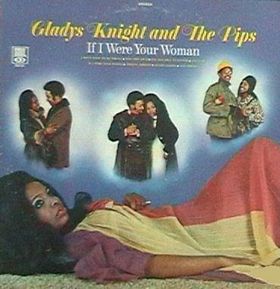
"If I Were Your Woman" by Gladys Knight and the Pips (1970)
Okay. I do admit it – my musical tastes have, on more than one occasion, been described as ‘gay’. It’s all good. I don’t happen to be gay, but as there’s no proven link between sexual preference and musical preference, all innuendo just washes off.
See, it’s all about the divas. I, you see, am a bona fide fan of divas. Not Mariah Carey – can’t stand her. Just the old school ones. Even at that, I am rather discerning with my divas. Allow me to elucidate.
I recently saw an ad touting a new season of “Canadian Idol” (the Canadian version of, surprise surprise, “American Idol”). Among the wannabes soundbited on the ad was a particularly histrionic woman screeching (as opposed to singing) “Come on and take it” (presumably to be followed, post-soundbite, by “Piece of My Heart”. We’re meant to watch and say ‘Hey! She can’t sing! She can only screech!’
People worldwide will hate me for saying this, but… That seems like a pretty decent imitation of Janis Joplin. I’ve never understood the appeal of Janis Joplin. She is, to me, what a diva should not be – aggressive, dissonant, indeed histrionic. What a diva should be… I’ve heard it said that power without strength is nothing. Having the pipes is nothing if you don’t know how to use them.
Observe Gladys Knight. With or without the Pips behind her, Gladys Knight can sing (so well, I’m tempted to spell it ‘sang’). To me, that means having a great instrument and having expert control over it. Diana Ross can exude personality, take you on a journey with the way she sells a song. But her pipes are not the most powerful. Aretha Franklin can tear the roof off of a church merely with her voice. But… wait. I can’t criticise Aretha Franklin – that’s a crime in certain jurisdictions. In any case, what Gladys has is the power and the glory. You can hear, or could at one point, an a capella version of this song on YouTube. It is a thing to behold. The girl can sing like hell. She’s broken hearted, she’s triumphant, she’s wilful, she’s dreamy. She sells it all so convincingly that you want to throttle the bugger that’s choosing some other girl over her. I mean, what, is he deaf?
There might be many out there who deride Motown and say that Gladys was at her best after Motown. I do know, especially from an instrumentation point of view, what they’re saying. But what Motown could do better than anyone out there is chain enough monkeys to typewriters that stunning compositions like this would come along often enough to keep everyone on top of their singles games (albums? Well… that’s what ‘greatest hits’ compilations are for…). In this particular case, the song is heartbreaking. The melody is as evocative as any screenplay and the dynamics tell as much as the words could ever hope to. For anybody suffering from a severe case of Jon-Cryer-as-Duckie-style unrequited love, this song couldn’t ring truer.
Difficult to imagine it happening to Gladys, mind you.
Lastly, the Pips, frankly more often an anchor than a set of wings, are perfectly fine in this song, staying to the background and making the gender-shift a little less annoying than it otherwise might be.
Thursday, September 10, 2009
"Born Slippy .NUXX" by Underworld (1996)
It’s a funny thing, memory. I was just listening the other day to Black Sabbath, to the Sex Pistols, to Nine Inch Nails. I even tried to listen to Led Zeppelin (couldn’t quite bear it, though). I was struck by the fact that songs that seem in our memories to be hard as nails turn out, listening again, to be soft little lumps of Jello. I mean, Ozzy Osbourne gurgling “I am Iron man!”? That’s comedy, not horror.
Which brings us to the present song, perhaps the only song in history to be harder than memory serves. Unlike so many songs that end by simulating dawn, this one starts in sunshine until the babbling words and thumping drums conspire to slowly drag you down.
Down where? Into hell? No, no, but at least into oblivion. This is a song that makes no sense pouring out of little computer speakers. It can only truly be observed on a crowded dance floor bathed in strobes and sweat. Apparently there are lyrics, though all I’ve ever heard is the words ‘boy’, ‘lager’ and ‘mega mega white thing’ over and over again. Of course, the lyrics aren’t the point at all.
Well, what is the point? Our boys in Underworld insist the song was all a joke. It’s apparently a remix of a song that I’ve never heard called “Born Slippy”. The remix was meant to be preposterous, its shouted vocals and relentless beats meant to be tongue-in-cheek.
Which goes to show you, of course, the truism that it is the people who create art who are least likely to be able to evaluate it. Additionally, it goes to show just how much Underworld themselves have stumbled aimlessly through their career like an escaped mental ward patient.
Underworld started in the early eighties in a group that, years before Prince did it, were known only as a squiggle, though they did relent and allow themselves to be called “Freur”. They then turned themselves into a crap band called Underworld, not to be confused with the middling band in question called Underworld. This one survived for precisely two albums., whose covers make them appear to have been Adam and the Ants or Sigue Sigue Sputnik or some nonsense.
Only after all that did Underworld, like the Bee-Gees before them, realize that they weren’t quite too old to start making the intelligent dance music that the kids were digging. Even at that, of course, though the music’s listenablility improved, they were still pretty much a failure. It took “Trainspotting”, the movie about Scottish junkies whose soundtrack was a defining feature of 90’s British musical ethos, to transform the two-year-old b-side of a flop single into an international hit and slice of ‘zeitgiest’.
Thank God for Scottish junkies.
It’s actually amazing in today’s more conservative musical climate to think that there was once a time when a song as extreme as this could even approach mainstream success. As it was, it was no Christmas number one, but it was ubiquitous enough that your grandmother might have spoke about ‘that strange song about lager’. Almost ten minutes long, largely amelodic thumping, it’s unlikely to inspire a Britney Spears cover. Yet there was a time when this is what radio sounded like.
That time was more than ten years ago now. And yet Underworld, active since the early eighties, are still soldiering on, unaware that they remain a 25-year one-hit-wonder.
Thursday, September 3, 2009
"They Don't Know" by Tracey Ullman (1983)
Music tends to be, in my experience, a struggle between irony and sincerity. With the advantage of added-on hipness, usually irony-mongers dominate the FM dial and critical opinion. Sincerity-mongers, on the other hand, often dominate the AM dial and are sneered at.
Thursday, August 27, 2009
"Mr. Jones" by Counting Crows (1994)
1994. My last year of high school and first year of university. "Alternative" music is as popular as it has ever been and ever will be. Kurt Cobain has just killed himself but Pearl Jam, Alice in Chains and God knows who else from Seattle are still there to keep up the overly serious moping.
I had spent my whole life listening to 'alternative' radio stations and watching 'alternative' video shows (yes, there was a time when non-music TV channels had 'video shows', just like they'd have a 'news broadcast'). This was a time for redemption! A time when my musical tastes were vindicated!
I was bored out of my mind.
Stuck in my university dorm with whiny white males shrieking at me on all sides, I became about as contrary as I could be. I responded by blasting out Neil Diamond and Johnny Cash - before they became cool, mind you, before Rick Rubin had 'rehabilitated' both of them in the minds of 'cool kids'.
I get no credit for my progressive music tastes...
Anyway, I was still very much into new music. There was a lot of new stuff I was digging and exploring at the time - both inside and outside the mainstream. Well, in any case, the 'mainstream/alternative' spectrum had been altered, and first-year university students are obsessed with being as 'alternative' as they can be (not just musically, of course), yet within that range I found myself with pretty catholic musical tastes.
Adam Duritz has found plenty of ways in the years since to annoy the bollocks off of me (dating Jennifer Aniston, for example). Yet this initial volley still inspires me. It's almost Dave Matthews Band or even Spin Doctors, and sooner or later it's bound to soundtrack a beer commercial, yet there is something real and genuine here. Wikipedia claims that Duritz suffers from dissociative disorder. I would have no idea about that, but if it's true, it would make a more than a little sense - or rather, this song might make a little more sense. I've never seen Counting Crows live, and if I've seen a video for this song it doesn't stick in my mind, but I imagine Duritz singing it in a kind of spaced-out reverie. He seems to be well in his own world here, emoting to and about his Dylan-rip-off acquaintance (note: if you're stealing your signature song's archetype from a Bob Dylan song, you might not want to actually say "I want to be Bob Dylan" in your lyrics). He doesn't quite take flight, but you sense that he performs this song without really any awareness of the people around him.
If it's so, that might be creepy, but it taps into something transportative about the best music that I constantly find myself looking for. Music should send the listener somewhere. It needn't send the performer somewhere, but if it does, it can create a bond between listener and performer - a bond, of course, later undone if the performer happens to be kind of a wanker. Adam Duritz is, clearly, speaking a load of rubbish here about whatever comes into his head ("Grey is my favourite colour; I felt so symbolic yesterday. If I knew Picasso, I would find myself a grey guitar and play") and I imagine listening to a dozen songs just like "Mr. Jones" would be a fresh hell. Yet as a one-off, as a novelty, "Mr. Jones" still works.
Thursday, August 20, 2009
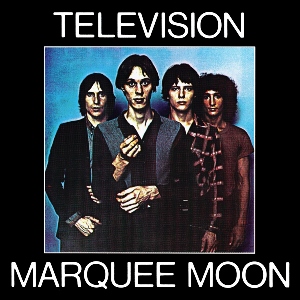
"Marquee Moon" by Television (1977)
Have you ever met the kind of music obsessive who seems dedicated to liking whatever critics like and hating whatever they don't? I've met a million of them - gritting their teeth while pretending to love Ornette Coleman, instinctively dissing anything by Britney Spears (some of whose songs are, in my opinion, great). I don't really get it, to be honest. I mean, just like what you like, right?
Having said that, however, I've been guilty in the past of taking critics too seriously - on more than one occasion buying an album without having heard a note just because critics seemed to like it. I have my requisite Velvet Underground and Sonic Youth CDs as well...
So, even though I would have been an infant and/or foetus at the time, I had, by my teenage years, educated myself enough about the CBGB 'scene' in New York to be able to fake it. I allowed myself to truly believe that a band like Blondie were in any way 'punk' (because CBGB was a proto-punk scene, right?)
I heard and loved the Talking Heads. I heard and liked Blondie and the Ramones. I heard and tried to like Patti Smith. I got the "New York 1970s" badge sewn onto my hipster-cred blanket. I knew, man.
Yet somehow Television eluded me. I mean, I'd read the magazines, so I knew who they were, but I'd never heard a song by them. Not until just a year or two ago, when finally I had the chance to hear this song.
By that point in my life, I was feeling rather bored with a lot of music. I found that, among current music, very little outside of the most mainstream pop moved me at all, and I found that I had pretty much no patience whatsoever for two-guitars-bass-and-drums - whatever the genre, if that was the instrumentation, it bored me.
Long wanking guitar solos bored me. Adenoidal male singers bored me.
Frankly, I wouldn't have expected to do anything but hate Television, even though the knee-jerk impulse to respect them because they were 'formative' or 'seminal' or whatever still remained. I won't say anything as banal as "they showed me the light" or whatever. After all, it was still just a song. Yet somehow, "Marquee Moon", two guitars, bass, drums, bad male singer, eleven minutes long, guitar solo more than four minutes long... somehow, unlikely as it is, moved me. Thirty years old, yet it still felt new. Seemed to suggest to me that you can do different things with two guitars, a bass and drums.
I'm not sure what it is actually. I'm not sure what seems so new or fresh. Perhaps it's the lack of pretense: the guitar solo goes on for minutes, but you never sense that the guitar player is arching his back and scrunching up his face like guitarists who are just so into the moment do. Perhaps it's the song's dynamics: the way it builds up and breaks down in a way that makes the minutes seem way, way less agonising than 10 minutes 40 seconds of, say, Phish would be. It could very well be that bass, flying all over the place unexpectedly (I love creative bass lines). Whatever it is, it hooked me. And it had been a long time since anything, especially guitar-based 'rock', had done that.
Although I still can't even begin to comprehend what on earth this possibly has to do with 'punk'.
Thursday, August 13, 2009
"Groove is in the Heart" by Deee-Lite (1990)
In deciding to make this list, I had originally toyed with the idea of itemising the 500 best songs ever, or something like that. I soon realised that that was a pretty bad idea, since it would involve major planning and organisation, and in the end, who cares if a song is 172nd best or 173rd best, right? So I decided not to list them in order.
Having said that, though, for this, my inaugural entry, I am including what I believe to be, without hyperbole, the best song ever. In any case, I’ve come to realise it’s my favourite song. And, at the end of the day, those are synonymous, right? I mean, you can’t really consider art and entertainment ‘objectively’ (try as you might). Roger Ebert may be able to justify his decisions till he’s blue in the face, but in the end a ‘thumbs up’ really just means that he liked the movie.
I like this song. Very, very much. For me, I think what is most wonderful about the song ‘Groove is in the Heart’ is its very generosity. There was something very giving and genuine about this song; not just the message of its lyrics but the ‘message’ of its music, its ‘feel’. The song, the band, the video… everything just seemed so completely accepting and open-minded. So much music, particularly ‘cool’ music, is filled with sneering and exclusion. With Deee-Lite, it really seemed like ‘coolness’ was being redefined to be as inclusive as possible. To cite a cliché, it was a party and everyone was invited.
And literally everyone… The band themselves were a slightly geeky Japanese-American, a slightly geeky Ukrainian-American and a glamorous American-born American. At a time when both Japan and the decaying Soviet Union were being cast by many Americans in the most xenophobic fashion possible, the simple image of these three people mixing it up together, not political in the ivory-tower sense but completely political in the personal-is-political sense. Special guests at their party included Q-Tip, leading light of the positivity style of hip-hop at the time and Bootsy Collins, funk bassist and over-the-top dresser extraordinaire. Special guest appearance, of course, by Herbie Hancock on exquisitely-utilised sample.
Except among true club kids and devotees, Deee-Lite were, for all intents and purposes, one-hit wonders. It’s amazing to shine this brightly this briefly. But perhaps it’s to be expected: they truly did throw everything they had into a single track. What remained to be said after this?
Defiantly optimistic, defiantly open-minded, defiantly sincere and defiantly ‘progressive’, I don’t think it’s possible to listen to this song and not feel uplifted. It’s 18 years later now, and the future they appeared to embody… well, it doesn’t really seem to have arrived yet. Still, though, listening to this song or watching the video gives you the sense – or perhaps merely the dream – that the better world they seem to represent is still coming. Sooner or later. One day…
Subscribe to:
Posts (Atom)